

If you’ve ever wondered “What’s in his stack?” — I’ve shared it all in one place.
👉 See my best picks
So let me guess…
You keep hearing people say they’re making money selling digital products.
eBooks, templates, guides, bundles — all that stuff.
And you’re sitting there wondering:
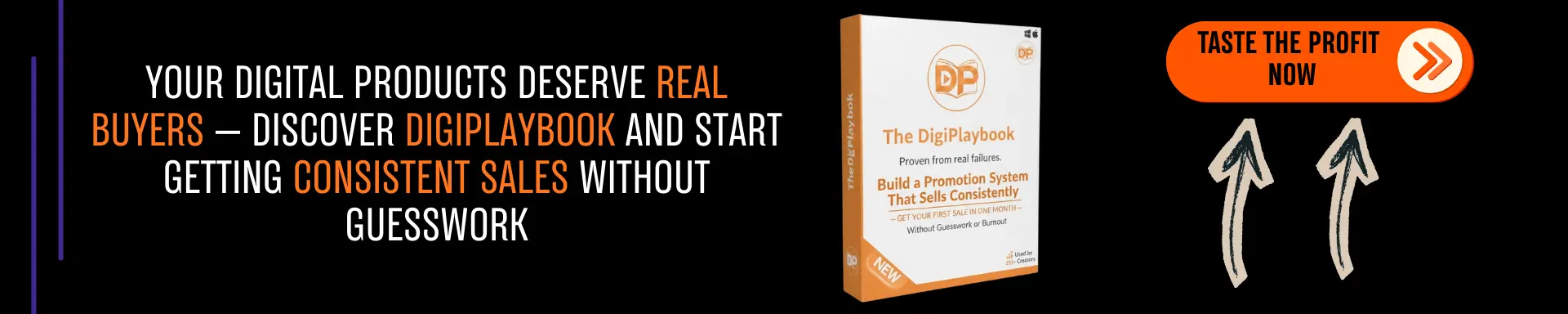
Your digital products deserve real buyers — discover Digiplaybook and start getting consistent sales without guesswork.
“Okay… but how does this actually work if I’m a beginner?”
Because creating something from scratch, setting up funnels, and magically getting sales sounds great in theory — but confusing in real life.
That’s fair.
No one wants to put in weeks of effort just to end up with zero sales and a bruised ego.
I know I wouldn’t.
That’s exactly why this guide exists.
Not theory.
Not hype.
Just the real 7-step process beginners actually follow to make their first digital sales — and then turn it into something consistent.
Step 1: Stop Chasing “Online Money” — Start Solving One Small Problem
Most beginners fail before they even start.
Why?
Because they try to “make money online” instead of solving one clear problem.
Digital products don’t sell because they’re fancy.
They sell because they save people:
- Time
- Confusion
- Effort
- Or mistakes
Examples of beginner-friendly problems:
- “I don’t know what to post on Pinterest”
- “I don’t know how to price my first product”
- “I don’t know what digital product to create”
Your job isn’t to be an expert.
Your job is to be one step ahead of the person you’re helping.
That’s it.
Step 2: Choose the Simplest Digital Product Possible
Here’s the truth no one likes to admit:
Your first digital product should be boring.
Not huge.
Not complex.
Not a 300-page masterpiece.
Beginner-friendly formats that actually sell:
- Short guides (PDF)
- Checklists
- Swipe files
- Templates
- Mini playbooks
Why?
Because speed beats perfection.
The faster you create, the faster you learn what sells.
Step 3: Validate Before You Build (Yes, Even as a Beginner)
You don’t need paid ads.
You don’t need surveys.
You don’t need a massive audience.
Validation can be as simple as:
- Google “People Also Ask” questions
- Reddit pain points
- Blog comments
- Facebook group questions
If people are already asking the question — they will pay for the shortcut.
This step alone saves beginners months of wasted work.
Step 4: Build Once, Sell Over and Over
This is where digital products quietly beat everything else.
You do the work once.
And the product can sell:
- While you sleep
- While you post content
- While you focus on traffic
It’s not “passive” in the lazy sense.
But it is leverage.
That’s why digital products scale — even with small traffic.
Step 5: Create a Simple Sales Page (Not a Fancy One)
You don’t need complex funnels.
Your first sales page only needs to answer 4 things clearly:
- What problem does this solve?
- Who is it for?
- What result will they get?
- Why should they trust you?
That’s it.
No hype.
No fake urgency.
Just clarity.
Clarity converts better than cleverness.
Step 6: Drive Targeted Traffic (Even 50 Visitors Is Enough)
Here’s something beginners underestimate:
You don’t need thousands of visitors.
You need the right ones.
Traffic sources that work extremely well for digital products:
- SEO blog posts
- Short-form content (repurposed)
One good article ranking for the right keyword can outsell 20 random posts.
That’s why SEO + digital products is such a powerful combo.
Read this :5 Promotion Mistakes That Stop Your Digital Product From Getting Its First Sale
Step 7: Follow a Proven System (Instead of Guessing)
This is the part most beginners skip — and pay for later.
Trying to figure everything out alone leads to:
- Overthinking
- Inconsistent action
- Random results
What actually works is following a clear, repeatable system:
- What to create
- In what order
- How to promote it
- How to get the first sale fast
That’s exactly why I created my DigiPlaybook.
It’s not theory.
It’s the same framework I personally use to:
- Choose digital product ideas
- Create them fast
- Promote them without sounding salesy
- And build consistent digital income step by step
If you’re serious about selling digital products without wasting months guessing, the DigiPlaybook gives you the entire roadmap in one place.
No fluff.
No overwhelm.
Just execution.
Final Thoughts
Selling digital products isn’t about luck.
It’s about:
- Solving a clear problem
- Packaging the solution simply
- And following a system that already works
Beginners don’t fail because it’s hard.
They fail because they don’t have direction.
Once you do?
Everything gets simpler — and scalable.
Your Next Step
If you want a clear, beginner-friendly system to go from idea → product → first sale,
you can check out the DigiPlaybook here.
It’s designed to be copied, not admired.

Hey! 👋 If this post saved you time, stress, or another “I give up” moment…
Do me a tiny favor? Share it with one friend who’s also grinding to make extra cash — but hates “guru” nonsense.
I don’t do fake scarcity, pop-ups, or “DM me for the secret.” Just real, messy, human advice.
When you share, you keep this blog alive… and help me afford more coffee (and fewer 3 a.m. panic sessions).
— Remon STS 💙